
Introduction
Two TCT circular saw blades can have the same diameter, bore, tooth count, and polished surface yet behave very differently in use. One may cut cleanly and remain stable through repeated production. Another may burn the workpiece, vibrate, chip carbide, or create inconsistent edges. The difference is rarely explained by a single visible feature.
For importers, distributors, hardware chains, and private-label brands, quality evaluation must answer two questions. First, is the proposed blade correctly specified for the customer’s material and machine? Second, can the supplier reproduce that performance consistently across a bulk shipment?
Short answer: evaluate TCT saw blade quality through five linked checks: application fit, dimensional accuracy, tooth and carbide integrity, dynamic cutting performance, and production-to-shipment consistency. Tooth count and tooth geometry—such as ATB or TCG—are essential, but they must be reviewed together with diameter, kerf, plate thickness, hook angle, bore, runout, carbide grade, brazing, tensioning, and packaging.
This guide provides a B2B inspection framework. It is designed to help buyers compare suppliers beyond price without pretending that one tooth count or one laboratory number fits every machine and material.
Safety note: Use only a blade whose diameter, bore, maximum speed, machine category, mounting arrangement, and application match the saw manufacturer’s instructions. Blade guards, correct installation, workpiece support, and required personal protective equipment are mandatory.
Define the Cutting Application Before Inspecting the Blade
A quality blade is an application-correct blade. A low-tooth-count ripping blade should not be rejected because it does not leave the finish of a high-tooth-count crosscut blade. A wood ATB blade should not be used as the benchmark for cutting aluminum extrusion. Inspection criteria must start with customer requirements.
Need a recommendation for your application?
Share your material, machine, size and target market. Our team will help you prepare a practical TCT Saw Blades starting specification.
Ask for these facts before requesting a sample:
- workpiece: solid wood, plywood, MDF, laminate, aluminum profile, non-ferrous metal, plastic, or another material;
- cut direction: ripping, crosscutting, panel sizing, trimming, or profile cutting;
- machine: handheld circular saw, table saw, miter saw, panel saw, or dedicated production equipment;
- blade diameter, bore, pinholes, kerf, plate thickness, and permitted speed;
- workpiece thickness and whether pieces are cut singly or in a stack;
- desired edge quality, feed rate, and production volume;
- dry cutting, lubrication, or other machine-specific process;
- current blade and the exact problem to solve.
LEUCO’s technical catalog notes that tooth design and tooth number depend on workpiece material, application direction, feed, spindle RPM, blade diameter, cutting quality, cutting height, stack height, and pass. That is a useful reminder: a tooth count table can suggest a starting point, but the real system decides the result.
How to Choose TCT Saw Blade Tooth Count
Tooth count changes the number of cutting edges engaged and the chip space available between teeth. In general, fewer teeth provide larger gullets and faster chip removal, which is useful for ripping and high-feed rough cuts. More teeth generally support a finer finish, but also reduce gullet volume and may increase heat if feed, chip load, or material is mismatched.
Bosch’s official Optiline guidance summarizes the common pattern for ATB wood blades: high tooth counts for cleaner results and lower tooth counts for solid cutting. The exact count still depends on diameter, material thickness, saw power, and cutting direction.
Practical starting logic
| Application | Typical tooth-count direction | Why | What to validate |
|---|---|---|---|
| Ripping solid wood | Lower | Larger chip space, productive feed | Tear-out, motor load, straightness |
| Crosscutting solid wood | Medium to high | More cutting edges for finish | Burn marks, feed rate, exit edge |
| Plywood and veneered panels | Higher, application-specific geometry | Reduce surface breakout | Top and bottom edge, scoring setup |
| MDF/particleboard/laminate | Higher and wear-conscious | Finish and abrasive board wear | Edge quality over repeated cuts |
| Aluminum/non-ferrous profile | Higher, purpose-designed geometry | Controlled chip formation and finish | Profile wall, clamping, lubricant, chip behavior |
Do not publish one universal tooth count for “wood, aluminum, and metal.” Diameter matters: 60 teeth on a 250 mm blade is not the same tooth pitch as 60 teeth on a 350 mm blade. The machine, workpiece engagement, and feed must be part of the recommendation.
ATB vs TCG Saw Blade Teeth
ATB: alternate top bevel
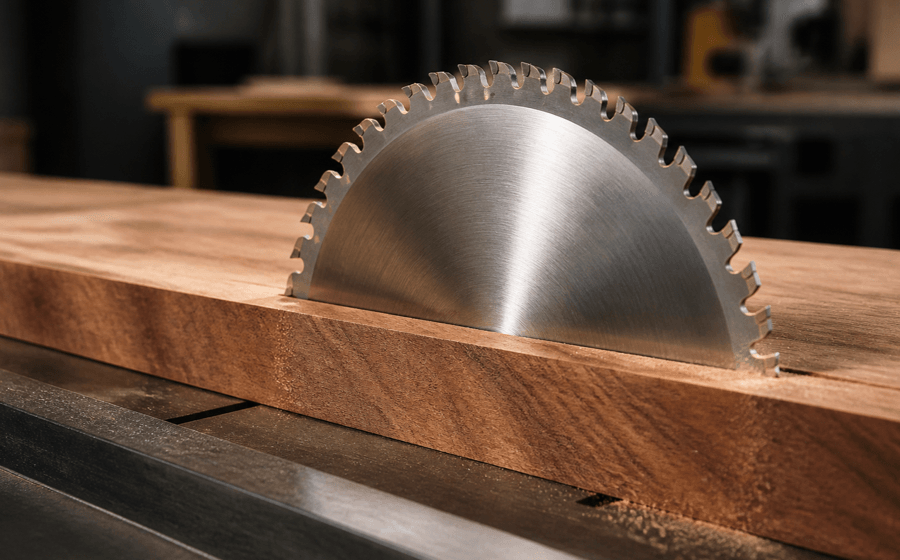
ATB teeth alternate a left and right top bevel. This shearing action is widely used for solid wood, crosscutting, plywood, and many general woodworking applications. The bevel can help cut fibers cleanly, but bevel angle, hook angle, tooth count, carbide, and machine stability influence the final edge.
ATB should not be reduced to “the wood tooth.” There are high-ATB, alternate-bevel combinations, and application-specific variations. A more aggressive bevel may improve edge quality in some panels but can change cutting forces and tooth durability.
TCG: triple chip grind
TCG alternates a chamfered or trapezoidal tooth with a flat raker tooth. The geometry shares the cutting work and is commonly used for abrasive panels, laminates, and non-ferrous metal applications. Freud’s circular saw blade catalogs list TCG across panel-sizing applications, while LEUCO identifies triple-chip and triple-chip-plus-flat configurations as distinct technical geometries.
TCG is not automatically superior. For natural wood crosscuts, a suitable ATB blade may provide the desired shearing action. For aluminum, the full design—including hook angle, tooth count, carbide, kerf, lubrication guidance, and machine—matters as much as the TCG label.
Other geometries buyers may encounter
- FTG or flat top grind: strong, efficient tooth form commonly associated with ripping and rougher cuts.
- Combination geometries: groups of beveled and flat teeth intended to balance ripping and crosscutting.
- High-ATB: steeper alternate bevel for finish-sensitive materials, with application-specific durability trade-offs.
- Hollow-ground, conical, or scoring geometries: used on selected panel and industrial systems.
Ask the supplier to name the geometry on the specification drawing. A product photo is not sufficient to approve a tooth form.
The Quality Features Importers Should Inspect
1. Steel plate and flatness
The plate must be suitable for the diameter, kerf, machine, and operating speed. Buyers should inspect surface condition, flatness, bore accuracy, pinholes, slots, and any signs of deformation. Plate thickness and kerf should match the approved drawing; making the plate too thin to reduce cost can affect stability.
Expansion slots and damping features vary by design. Their presence does not automatically prove low noise or low vibration. Ask what function they serve and compare the complete blade under controlled cutting conditions.
2. Runout and concentricity
Axial and radial runout can affect vibration, kerf consistency, edge quality, and tooth loading. Measurement method matters: fixture accuracy, contact point, reference surface, cleanliness, and instrument calibration can change the reading.
Instead of demanding an arbitrary internet tolerance, agree on the measurement standard and acceptance value for the specific blade family. Record the gauge method on the inspection sheet. During shipment inspection, sample units should be measured using the same procedure used for approval.
3. Carbide tip material and dimensions
Carbide grade must balance wear resistance and toughness for the application. Abrasive boards may favor strong wear resistance; interrupted cuts and difficult profiles can require greater resistance to chipping. Buyers should not accept “virgin carbide” or a color code as a complete technical specification.
Verify:
- carbide grade or an agreed supplier specification;
- tip dimensions and consistency;
- tooth geometry and grind finish;
- edge chipping under magnification;
- correct tip orientation;
- traceability of the approved material.
If independent material testing is required, define the test and sampling plan before order confirmation. A laboratory report from an unrelated batch is not shipment evidence.
4. Brazing and tooth seating
Each carbide tip must be positioned and attached consistently. Visual inspection should look for misalignment, excessive or incomplete braze appearance, contamination, cracked tips, and irregular tooth seating. Where the supplier performs attachment-strength or process-verification tests, ask how the method is controlled and how often samples are taken.
Do not rely on a destructive test video without batch identification. The useful question is whether the process settings, operator checks, and lot records are connected to the order being shipped.
5. Grinding accuracy
Tooth grinding determines bevel, top and face geometry, edge condition, and consistency around the blade. Under magnification, look for chipped edges, burn discoloration, burrs, and unequal geometry. Compare a sequence of teeth, not only the best-looking tip.
For production blades, resharpening allowance may also matter. If your customers resharpen locally, clarify the usable carbide dimensions and intended service cycle.
6. Tensioning and dynamic stability
Circular saw plates are tensioned to support stable running at operating conditions. Static appearance does not fully reveal dynamic behavior. A supplier may use tensioning, straightening, and runout controls, but a cutting test on the intended machine remains necessary.
Signs of a mismatch can include wandering cuts, unusual vibration, excessive noise, changing kerf, burn marks, and unstable feed. These symptoms can also come from the machine, mounting, dirty flanges, worn bearings, poor workpiece support, or incorrect use. Troubleshooting must separate blade and machine variables.
7. Marking and packaging
A technically good blade can still create commercial risk if markings or packaging are wrong. Review brand, diameter, bore, kerf if stated, tooth count, tooth geometry or material application, maximum speed, rotation direction, warnings, barcode, traceability, country/language requirements, and carton quantity.
Packaging should protect the carbide tips and plate during long-distance handling. Inspect inner packs, separators, moisture protection where appropriate, carton strength, palletization, labels, and mixed-SKU controls. Shipment inspection should include barcode scanning and carton count, not only blade appearance.
A Controlled Factory Testing Plan
The best sample test is repeatable enough to compare products. It does not need to imitate every customer, but it should represent the main product application.
Prepare the test
- Use the same maintained machine, flange condition, and mounting procedure.
- Use workpieces from the same material batch where possible.
- Record material type, thickness, moisture or profile details relevant to cutting.
- Keep cutting direction, depth, feed method, and pass conditions consistent.
- Identify every blade with a sample code; do not rely on memory.
Record the result
Useful observations include:
- entry and exit edge quality;
- top and bottom surface chipping;
- cutting time or controlled feed rate;
- sound and vibration observations;
- motor load or current where the setup supports it;
- burn marks, pitch build-up, or chip welding;
- kerf consistency and cut straightness;
- carbide edge condition after a defined number or length of cuts;
- plate condition after cooling.
Photos should use consistent lighting and scale. Keep both acceptable and failed examples in the approval record. This makes later quality discussions more objective.
Mid-article CTA — Ask for a Sample & QC Plan
Send your blade size, tooth count, material, machine, target cut quality, current benchmark, and private-label requirements. Bevin Tools can organize a specification review, sample proposal, and agreed inspection checklist.
Button: Send Your Requirements →
/inquiry?product=tct-saw-blades
From Approved Sample to Bulk Shipment
A frequent sourcing failure occurs after a good sample: the bulk order is produced with an undocumented change in carbide, plate, grinding, or process settings. Prevent this through change control.
Build an approved specification pack
The pack should include:
- signed dimension drawing;
- material and application description;
- steel plate, carbide, kerf, plate thickness, geometry, and angle specifications;
- runout measurement method and agreed acceptance criteria;
- approved sample code and test record;
- permanent marking artwork;
- retail package and export carton artwork;
- packing method and carton quantity;
- inspection checklist and sampling plan;
- requirement for approval before material or process substitution.
Use in-process controls
Final inspection cannot economically detect every process problem. Ask the supplier how it controls incoming plate and carbide, brazing settings, tensioning, grinding, runout, cleaning, marking, and packaging. The answer should name checks and records, not simply say “100% quality control.”
Plan pre-shipment inspection
Shipment inspection may include quantity reconciliation, SKU and artwork match, dimensions, bore, kerf, plate thickness, runout samples, tooth appearance, marking, packaging, barcode, carton drop or strength checks where agreed, pallet condition, and retained samples. Functional cutting tests can be added according to a documented lot-sampling plan.
If an inspection fails, define containment: identify affected lots, increase sampling, review records, rework where technically acceptable, and obtain buyer approval before release. Do not hide a failed result behind an average.
How to Compare TCT Saw Blade Suppliers Beyond Price
Use a weighted scorecard. A practical distribution may be:
| Evaluation area | Suggested weight | Evidence |
|---|---|---|
| Application match and technical response | 25% | Complete proposal, questions asked, drawing |
| Sample cutting performance | 25% | Controlled test record and retained sample |
| Production and QC control | 20% | Process flow, gauges, records, change control |
| Commercial fit | 15% | Price, MOQ, mix, lead time, payment terms |
| OEM packaging and compliance support | 10% | Artwork workflow, markings, carton plan |
| Communication and corrective-action discipline | 5% | Response clarity, ownership, traceability |
Adjust the weights for your market. A replacement-blade wholesaler may emphasize commercial mix; an industrial panel customer may emphasize process capability. The value of the scorecard is that all suppliers answer the same questions.
Common Problems and Likely Causes
Burning or scorch marks
Possible causes include too many teeth for the feed, dull or incorrect geometry, resin build-up, slow feed, machine alignment, unstable plate, or unsuitable blade application. Inspect the system before assuming the carbide is simply “not sharp.”
Chipped carbide teeth
Possible causes include impact, hidden fasteners, incorrect application, poor workpiece clamping, feed shock, insufficient carbide toughness, grinding damage, brazing problems, or transport damage. Map the tooth positions and review packaging as well as production.
Rough or torn edge
Possible causes include incorrect tooth count or geometry, dull teeth, runout, vibration, cutting direction, unsupported workpiece, excessive feed, or machine alignment. Photograph both entry and exit surfaces.
Noise and vibration
Possible causes include dirty or damaged flanges, bore mismatch, plate runout, machine bearings, incorrect blade tension, unstable workpiece, tooth damage, or excessive speed. Stop and investigate rather than continuing a potentially unsafe cut.
Frequently Asked Questions
How do I choose the right tooth count for a TCT wood saw blade?
Start with diameter, material, thickness, ripping or crosscutting, machine power, and desired finish. Lower tooth counts generally support chip clearance and faster ripping; higher counts generally support cleaner crosscuts. Validate on the intended machine and workpiece.
Is ATB or TCG better?
ATB is widely used for wood and panel applications because alternating bevels shear fibers. TCG is commonly used for abrasive panels, laminates, and non-ferrous metals because the chamfered and flat teeth share cutting work. Neither is universally better; choose by material, machine, and finish requirement.
What runout is acceptable for a TCT saw blade?
There is no responsible universal value for every diameter and application. Agree on the measurement fixture, reference surface, gauge location, blade family, and acceptance criterion with the supplier. Use the same method for sample approval and shipment inspection.
How can I verify carbide quality?
Approve a documented carbide specification, inspect tip dimensions and grinding under magnification, test multiple blades in the intended application, and use independent material analysis only when it is commercially justified and tied to the actual batch.
Should I test one sample before ordering?
One sample is useful for early fit, but multiple samples are better for judging consistency. Retain the approved reference, document the cutting test, and require change approval before bulk production.
What should be included in OEM saw blade artwork?
At minimum, verify brand, blade size, bore, tooth count, intended application, maximum speed, rotation direction, required warnings, traceability, barcode, language, carton count, and destination-market requirements. Technical and packaging approvals should be signed separately.
How do I reduce quality risk when sourcing TCT blades from China?
Use an application-based specification, compare controlled samples, approve drawings and artwork, audit or review process controls, prohibit unapproved substitutions, and conduct a shipment inspection tied to the approved reference. Country of origin alone does not replace supplier-level verification.
Conclusion
Evaluating a TCT saw blade requires more than counting teeth or viewing a polished plate. Importers should connect the application to tooth count and geometry, then verify plate accuracy, runout, carbide, brazing, grinding, dynamic cutting behavior, marking, and packaging.
The strongest protection is continuity from customer requirements to shipment: one approved specification, one documented sample method, controlled production settings, clear change approval, and a final inspection that checks the same features. This approach helps distributors compare suppliers on total commercial risk rather than on price per blade alone.
Final CTA: Build a TCT Blade Specification for Your Market
Share your material, machine, diameter, bore, kerf, tooth count, application, benchmark, packaging, and order estimate. Bevin Tools can help organize a product-matching discussion for a distributor range or private-label program.
Primary button: Get a Quote → /inquiry?product=tct-saw-blades Secondary button: Ask for Product Catalog → /contact?request=catalog
Technical References
- Google Search Central: Optimizing for generative AI features
- Bosch Professional: Optiline Wood circular saw blades
- LEUCO: General program and circular saw blade technical information
- Freud: Circular saw blades catalog
Editorial note: Inspection values and product recommendations must be finalized for the specific diameter, machine, material, use conditions, and buyer requirements. This article does not replace the machine or blade manufacturer’s instructions.